

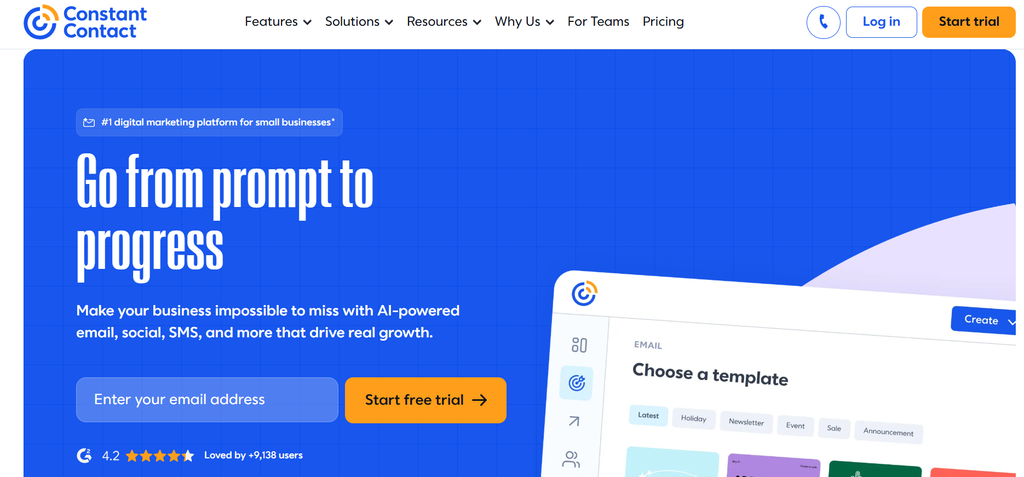
Constant Contact is a digital marketing platform designed to help businesses communicate with customers, build audiences, and manage campaigns from one place. Email marketing remains one of its primary strengths, but the platform also provides tools for social media, SMS, automation, contact management, reporting, and lead generation. Its drag-and-drop editor and professionally designed templates make campaign creation accessible to users without advanced design or coding skills. Constant Contact also incorporates AI-powered features that can assist with creating marketing content and adapting campaigns for different channels. This combination makes the platform suitable for small businesses, organizations, and growing brands that want to simplify their marketing activities while maintaining a professional appearance across customer communications.
Creating Professional Emails Without Complexity
One of Constant Contact’s most noticeable strengths is its email creation experience. The platform offers a drag-and-drop editor and a large selection of professionally designed templates, allowing users to create campaigns without building every element from the beginning. Text, images, layouts, buttons, and branding can be customized according to individual requirements. This can be particularly useful for smaller teams that do not have dedicated designers or technical specialists. Users can schedule campaigns and monitor important engagement information after sending them. The straightforward interface helps reduce the learning curve associated with email marketing. For businesses that want to create attractive newsletters, promotional messages, announcements, or customer updates without unnecessary technical complexity, this approach can make regular campaign management considerably easier.
Automation Helps Maintain Customer Engagement
Automation is another significant component of the Constant Contact experience. Businesses can create automated communications that respond to specific customer actions or predefined triggers. Examples can include welcome messages, abandoned-cart reminders, birthday emails, follow-ups, and re-engagement campaigns. These workflows reduce the need to manually send repetitive communications while helping businesses maintain consistent contact with their audiences. Constant Contact also supports automated SMS and email communication, giving marketers additional ways to reach customers. More advanced workflows can use different conditions and actions to create personalized customer journeys. However, automation capabilities differ between subscription levels, so businesses should review the features included with each plan before making a decision. For organizations managing recurring customer communications, automation can provide a practical way to save time.
AI And Multichannel Marketing Tools

Constant Contact has developed beyond conventional email marketing by introducing AI assistance and additional marketing channels. Its AI tools can help users generate content for emails, text messages, and social media posts, which can be useful when marketers need to produce campaign copy quickly. Email content can also be adapted for social media, helping businesses reuse ideas across different channels. Alongside email, users can access tools for social posting, landing pages, advertising, and SMS marketing. Managing several activities from one platform can simplify workflows for smaller marketing teams. At the same time, businesses with highly specialized advertising requirements may still prefer dedicated platforms for certain channels. Constant Contact’s multichannel approach is therefore most useful for companies seeking convenience and centralized campaign management.
Contact Management Supports Audience Growth
Effective contact management plays an important role in successful marketing, and Constant Contact provides several ways to build and organize an audience. Businesses can use signup forms, landing pages, surveys, and other tools to collect new contacts. These contacts can then be arranged into lists and segments, helping marketers deliver more relevant communications to different groups. Constant Contact also provides integrations with external business applications, allowing information to move between connected systems. This can be useful for businesses already using ecommerce platforms, CRM software, or other digital tools. Better organization can make it easier to understand audiences and maintain accurate contact information. For growing businesses, having contact collection, organization, segmentation, and communication tools available within the same marketing environment can help create a more streamlined workflow.
Reporting Helps Measure Campaign Performance
Understanding campaign performance is essential for improving marketing decisions, and Constant Contact provides reporting tools to help businesses monitor audience engagement. Depending on the selected plan, users can review metrics associated with email campaigns and other marketing activities. Information about opens, clicks, and engagement can help marketers understand how audiences respond to different messages. These insights can then be used to adjust content, timing, subject lines, and overall campaign strategies. More advanced reporting capabilities are available on higher-level plans, giving businesses additional ways to examine performance. However, companies requiring extremely detailed attribution or sophisticated customer journey analytics may eventually need specialized analytics solutions. For everyday marketing campaigns, the reporting features can provide useful information without requiring users to become data-analysis experts.
Plans Offer Different Marketing Capabilities
Constant Contact provides several subscription options, with available features changing according to the selected plan and audience size. Its plans are designed to accommodate different marketing requirements, with higher tiers providing access to additional automation, segmentation, reporting, and other capabilities. Pricing can also depend on the number of contacts in an account, so businesses should consider both their current audience and expected future growth when evaluating costs. A free trial allows potential customers to explore the platform before committing to a subscription. Smaller organizations may find that a basic plan covers their essential requirements, while larger teams may need additional functionality. Comparing the included features against actual marketing needs can help businesses determine which subscription level aligns with their campaign volume and objectives.
Conclusion: A Versatile Marketing Platform

Constant Contact brings together email marketing, automation, contact management, social media, SMS, reporting, and other digital marketing capabilities within one platform. Its user-friendly campaign builder and templates can make professional marketing more accessible, while automation can reduce repetitive tasks and help businesses maintain regular communication. AI features add another layer of convenience for content creation and multichannel campaigns. The availability of different plans also gives businesses flexibility when selecting features based on their requirements. However, organizations with highly advanced analytics or specialized marketing workflows may still need additional software. Overall, Constant Contact presents a practical option for businesses looking for a centralized marketing platform that combines ease of use with a broad selection of tools for customer communication and audience growth.